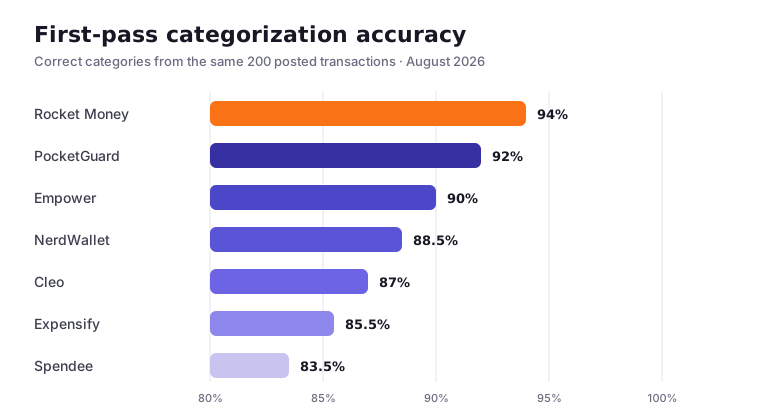
Accuracy matters more than an impressive chatbot. A tracker that quietly files a pharmacy purchase under Shopping or a commuter train under Travel corrupts category totals and every recommendation built on them. From August 1–5, 2026, we connected each app to the same controlled account, recorded its untouched labels, and compared them with a human-checked answer key.
| Rank | App | Correct / 200 | Accuracy | Most common miss |
|---|---|---|---|---|
| 1 | Rocket Money | 188 | 94% | Warehouse clubs |
| 2 | PocketGuard | 184 | 92% | Mixed retail |
| 3 | Empower | 180 | 90% | Digital wallets |
| 4 | NerdWallet | 177 | 88.5% | Local restaurants |
| 5 | Cleo | 174 | 87% | Peer-to-peer payments |
| 6 | Expensify | 171 | 85.5% | Personal transfers |
| 7 | Spendee | 167 | 83.5% | Subscriptions |
#How we ran the 200-transaction test
Our answer key used 12 practical categories, including groceries, dining, transport, utilities, medical, shopping, income and transfers. The account contained purchases posted from February 1 through July 31, 2026, with national chains, small local merchants, refunds, digital-wallet descriptors and recurring charges represented. We judged the label shown after the initial sync; even an easy-to-fix error still counted as wrong.
We excluded cash purchases and receipt scanning because not every app supports them. We also ignored merchant-name cleanup, budget advice and subcategory depth when calculating accuracy. Those features informed our editorial notes, but the ladder itself answers one narrow question: which free tracker gets the raw category right most often? See our review methodology for the broader scoring rules used elsewhere on CoinLadder.
#1. Rocket Money — 94%
Rocket Money made 12 errors, the fewest in the field. It handled recurring bills, rideshares and restaurant descriptors especially well, and its corrections were easy to turn into future rules. The free plan provides account linking and useful spending summaries, though serious subscription cancellation help and deeper budgeting tools still push toward Premium. It is the best default for readers who want accurate automation first.
#2. PocketGuard — 92%
PocketGuard finished only four correct labels behind the winner. Utilities and transport were nearly flawless; mixed merchants such as big-box stores caused most mistakes. Its appeal is the clear “In My Pocket” number after bills and goals, not endless analysis. Free users should check the current limits on custom categories, but the core view remains quick and unusually legible.
#3. Empower Personal Dashboard — 90%
Empower correctly filed 180 transactions and gave the best no-cost net-worth context. Investment, cash and card balances sit in one dashboard, making it more complete than a simple spending log. Digital-wallet purchases confused it more often than the top two, and category editing feels secondary to wealth tracking. Pick it when “free” must mean an ongoing dashboard rather than a funnel to budgeting features.
#4. NerdWallet — 88.5%
NerdWallet is a sensible free choice for people who want credit monitoring and educational context alongside transaction tracking. It was reliable on bills and mainstream retailers but less certain with independent restaurants. The interface explains financial patterns clearly without demanding a formal budgeting method. Its 23 errors keep it off the podium, yet its wider financial overview delivers real value at no charge.
#5. Cleo — 87%
Cleo wraps tracking in a conversational assistant, which makes quick questions about recent spending feel natural. The underlying categorization was respectable, not exceptional: peer-to-peer payments and transfers accounted for many of its 26 misses. The free experience suits users motivated by chat-style check-ins. Cash advances and coaching tiers are separate considerations, so judge the tracker before paying for extras.
#6. Expensify — 85.5%
Expensify is strongest when expenses begin as receipts, especially for freelancers separating reimbursable work from personal spending. On our bank-transaction-only test, it correctly categorized 171 entries. Transfers and ambiguous personal purchases reduced its score, while business meals and travel were handled well. Choose it for receipt-led workflows; a general household budgeter will find the top four more natural.
#7. Spendee — 83.5%
Spendee has a friendly visual ledger and useful shared-wallet concepts, but it recorded 33 first-pass errors, including several recurring digital services. Manual correction is painless, so the lower accuracy is manageable for an involved user. Its free plan works best as a handsome spending journal; automatic bank connections and plan limits vary, making it less compelling as a set-and-forget AI tracker.
#One additional free option
We also tried Quenzio’s free AI budgeting app; its explanations were clear and beginner-friendly, but we did not include it in the seven-app accuracy ladder because its available import flow did not reproduce the full controlled dataset consistently.
Rocket Money wins on accuracy; Empower wins on pure free value
On August 8, 2026, Rocket Money is our first recommendation because a 94% correct first pass means fewer repairs and more trustworthy category totals. PocketGuard is close and offers the simplest safe-to-spend view. Empower is the better choice for readers who prioritize a broad, permanently free dashboard over active budgeting. Recheck plan limits before connecting accounts: free tiers change faster than categorization engines.
#Frequently asked questions
Rocket Money led our August 2026 benchmark with 188 correct first-pass categories out of 200, or 94%. PocketGuard followed with 184 correct, or 92%.
Every ranked app offered a usable no-cost plan on August 8, 2026, but some reserve custom categories, exports, rules or coaching for subscribers. Empower and NerdWallet offered the broadest ongoing free dashboards in our test.
We compared each untouched first-pass label with a fixed 12-category, human-checked answer key for the same 200 posted transactions. A category counted as correct only when it matched before any manual edit or rule.